National Depression Glass Association
Preserving America's Glass Manufacturing Heritage
Anchor Hocking's Manhattan Pattern
by Rosemary Trietsch
Manhattan is one Depression glass pattern that many people don't
recognize as 'Depression glass'. It doesn't fit into the usual
framework that so many of us think of when we hear the words
'depression glass.' It's not delicate with fancy edges. There are
no flowers or etching, and it's most often found in crystal, not
the 'typical' depression greens, yellows, blues and pinks. It looks
'too 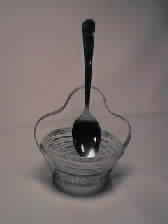 modern to be that old', a discussion I've had about Manhattan with
many of those poor non-collecting souls who are dragged along to
glass shows. I have found that people who hate Depression glass,
like the Manhattan pattern for all the things it isn't: namely,
'typical depression glass.' (Now, we collectors know better than to
even think such a thing. But as it's nice of these folks to drive
us
modern to be that old', a discussion I've had about Manhattan with
many of those poor non-collecting souls who are dragged along to
glass shows. I have found that people who hate Depression glass,
like the Manhattan pattern for all the things it isn't: namely,
'typical depression glass.' (Now, we collectors know better than to
even think such a thing. But as it's nice of these folks to drive
us 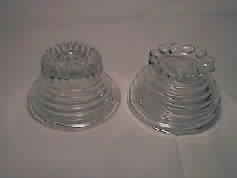 to shows and
wait while we examine every single piece of glass that's there,
let's be a little tolerant ... for now.)
to shows and
wait while we examine every single piece of glass that's there,
let's be a little tolerant ... for now.)
Manhattan was produced by Anchor Hocking from 1938 to 1943. Crystal is the most common color, though pink, ruby, green and iridescent were also made. With the exception of the 3-footed candy dish - and perhaps the sugar, creamer and relish insert - pink is difficult to find and expensive when you do find it. Tumblers are the only piece 'commonly' found in green or iridescent, and ruby production was limited to the 24-oz ball jug pitcher and the triangular relish inserts. You will also find Manhattan pieces with metal accessories such as handles and spoon holders. Other companies made the metal parts; Hocking only supplied the glass.
Color, though, is not nearly as much of a problem to Manhattan
collectors as condition is. The Manhattan pattern is made up of
concentric ribs. These ribs are pointed so that if you rub your
fingernail across them, it will catch on each one and you can hear
a little 'ting'. (The 'ting test' is one way to tell Manhattan from
some look-alike pieces, though the ball jug pitcher is the
exception, as it has rounded ribs.) Of course, this means that
every piece of Manhattan is covered with edges. Add to this closed
handles with ribs and pointed edges, and you have a chip waiting to
happen. (As one frustrated collector said to me 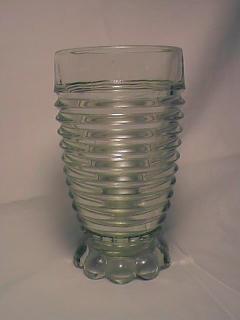 while
examining the 14-inch relish tray, "The whole #*&$^ plate is an
edge!") Manhattan pieces also tend to be heavy because of all the
glass that went into making the ribs, and, although this adds to
the potential for damage, many collectors feel this is part of its
appeal. Because it's not paper-thin, people are less nervous about
using it around clumsy relatives.
while
examining the 14-inch relish tray, "The whole #*&$^ plate is an
edge!") Manhattan pieces also tend to be heavy because of all the
glass that went into making the ribs, and, although this adds to
the potential for damage, many collectors feel this is part of its
appeal. Because it's not paper-thin, people are less nervous about
using it around clumsy relatives.
There are a few pieces that can be confusing to new collectors. The 5 3/8 inch handled berry bowl is sometimes passed off as the 5 ¼ inch cereal bowl. Remember, the cereal bowl has no handles and sells for 3 times the price of the berry. The relish tray and inserts tend to cause confusion for a few reasons. First, the triangular relish inserts came in crystal, pink and ruby, while the 14-inch tray and the round center insert were only made in crystal.
(There are a lot of people out there looking for these pieces in color.) Second, the sherbet is often mistaken for the round insert. The sherbet has a beaded foot while the insert has straight ribs around the base. Last, the 14-inch plate also came divided into 4 parts. Try as you might, you can't get all five triangular inserts to work in that four part tray. (Yup, people have complained about that one, too.)
Perhaps the hardest thing for the collector and novice alike, is
the amount of ribbed glass that looks like 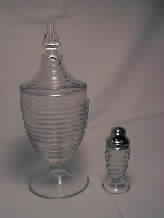 Manhattan but
isn't. Anchor Hocking produced Park Avenue in 1987 as a deliberate
look-alike for Manhattan. (Those clever marketing people recognized
the modern appeal of the old pattern and found a way to capitalize
on it.) Hocking was careful however, to maintain the integrity of
the old glass by changing the shapes and colors of this new
pattern. If you find a piece that you think is Manhattan but the
measurements don't match what you find in your Depression glass
encyclopedia, you've got something else.
Manhattan but
isn't. Anchor Hocking produced Park Avenue in 1987 as a deliberate
look-alike for Manhattan. (Those clever marketing people recognized
the modern appeal of the old pattern and found a way to capitalize
on it.) Hocking was careful however, to maintain the integrity of
the old glass by changing the shapes and colors of this new
pattern. If you find a piece that you think is Manhattan but the
measurements don't match what you find in your Depression glass
encyclopedia, you've got something else.
There are some look-alikes, however, that were contemporary with
the original Manhattan and have been used with it all along.
Hocking made a decanter and water bottle that have the same rounded
ribs as the ball jug pitcher, and many collectors include these as
part of their collections. Hazel Atlas produced the covered candy
jar and salt shaker pictured at left. Both of these pieces are so
widely accepted as "go-with" pieces that they're included 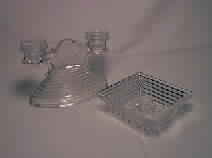 in the
regular Manhattan listings. The reason for the shaker's appeal is
that the Hocking shaker is square and just doesn't seem to fit in
with all those concentric rings. This is also true for the
candlestick, which was made from the same mold as the square
ashtray and just doesn't compliment the large open handled bowl the
way the L.E. Smith double candlestick does (both items shown at
right).
in the
regular Manhattan listings. The reason for the shaker's appeal is
that the Hocking shaker is square and just doesn't seem to fit in
with all those concentric rings. This is also true for the
candlestick, which was made from the same mold as the square
ashtray and just doesn't compliment the large open handled bowl the
way the L.E. Smith double candlestick does (both items shown at
right).
Once in a while, in my hunt for pieces of Manhattan for my
husband's collection, interesting things have turned up. The green
tumbler, pictured above and to the right, was a lucky find, as was
the relish insert in the metal holder. The handled plate shown at
right, however, is our most intriguing find. It looks and feels
like Manhattan, but the tab handles are unique. I 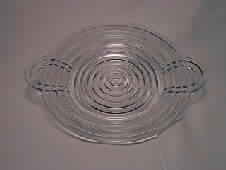 knew I had
seen a reference to it somewhere and finally came across it again:
Hazel Marie Weatherman pictures this plate with a domed metal lid
in the Supplement to Book 2, and calls it a butter dish. She was
unable to find it in any Hocking listing, but thought it such a
close relative to Manhattan that she named it "New York" Unless one
turns up in its original box or an old advertisement, we'll never
know.
knew I had
seen a reference to it somewhere and finally came across it again:
Hazel Marie Weatherman pictures this plate with a domed metal lid
in the Supplement to Book 2, and calls it a butter dish. She was
unable to find it in any Hocking listing, but thought it such a
close relative to Manhattan that she named it "New York" Unless one
turns up in its original box or an old advertisement, we'll never
know.
Finally, a warning: Heisey's Ridgeleigh has been known to masquerade as Manhattan on more than one occasion. If you should see a piece hiding among the relish inserts, approach slowly, remove it carefully and try not to act too excited as they've been known to bolt. After all, paying Hocking prices for Heisey is one way to support your 'glass habit'!
Webmaster's Note: The author is an NDGA Board member, dealer, collector and co-owner of JustGlass.com, a web site with a host of information pertaining to glass as well as glass for sale. We thank Rosemary for permission to reproduce her article.